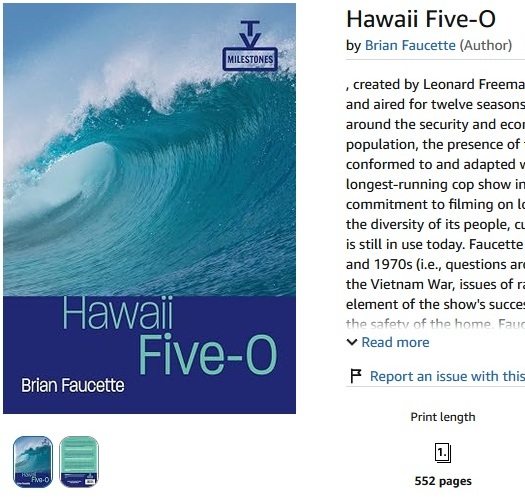
(As anyone familiar with Hawaii Five-O knows, Karen Rhodes’ Booking Hawaii Five-O, published almost 30 years ago (1997) is the book about (and the first one published about) the TV show. So when I found out a “new” book about H5O had appeared, I had to check it out. I ordered it from Amazon Canada, thinking that it was 552 pages long (as per the information in the Amazon Canada listing). I was shocked when it was delivered to my house by the Amazon Prime guy, I thought the envelope was empty! (The book’s number of pages was correctly identified as 121 on the Amazon Canada listing further down the page) ... and it cost $32.95 to boot! (The Amazon.com (US) price is $24.99.) I promptly told Karen about this book, and she ordered it too. She did not like it... – Mike Quigley)
Book Review: Hawaii Five-O by Brian Faucette (Detroit: Wayne State University Press, 2022). Part of the publisher’s “TV Milestones” series.
by KAREN RHODES
Did you ever bullshit a question on a college exam?
That’s what this book reads like. Or like it was hastily generated to meet “publish or perish” pressure.
I did some basic research on Brian Faucette. He doesn’t appear to still be on the faculty of Caldwell Community College and Technical Institute. While that institution, for some strange reason, does not list its faculty, like every other institution of higher education I’ve ever taken a gander at does, I have had to do some indirect research to examine the question of where he is.
The conclusion of that examination is: I don’t know. One of the most important documents any academic can produce is his or her curriculum vitae, their academic biography. Most academics publish their curriculum vitae somewhere, so people who might want to, say, give him or her a job at a college or university, can find them. For example, I just did a Google search for the curriculum vitae of my major professor, J. Michael Francis, Ph.D., and it took about 2 seconds for the link to come up. I searched for Brian Faucette’s curriculum vitae, and got nothing. I can’t find much about him at all. One site, ResearchGate, devoted to their “legitimate goal of comprehensive and accurate scientific recordkeeping,” lists Faucette, but only a minimum of information about him, as he has not put up a profile for himself. The four publications listed on this site, four journal articles, were published between 2012 and 2014. None of these have been cited in other works.
Medium also lists him with two publications, from 2015 and 2021. The site also lists his 30 followers. But neither ResearchGate nor Medium has any information about his current whereabouts, nothing about any affiliation with any academic institution. Why has he dropped off the radar? I don’t know. But keep reading.
On to the book.
One of the first things I noticed is that the book is tiny, about 3″×6″. My book, Booking Hawaii Five-O (BH5-O) is roughly 4″×8″. BH5-O is 332 pages; this book is 121. It is the smallest and shortest book I’ve ever seen published by a university press, in this case Wayne State University Press, in Detroit, Michigan.
I find the book to be not terribly coherent. Seems to me – though I’m not to be considered “an Academic” in the sense of having published scholarly books or articles – that he cherry-picked quotes from learned journals and scholarly books without really doing any real analysis. He doesn’t question any of the statements in these journals and books he has referred to or quoted. He doesn’t point out any contradictions in or between them. He gives no synthesis of meaning of these statements. Mike Quigley, on his website, and me in my book, offer better analyses of Five-O’s meaning and message than this guy does.
On pages 12 and 13 of his book, Faucette damns me with faint praise when he criticizes one author (Douglas Snauffer, Crime Television) because he “does not offer a sustained critical analysis of the show, instead focusing more on plot summaries and information about the show’s background and ratings history. It is a model that Karen Rhodes adopts in her book . . . in which she uses more of a fan approach, with episode guides and some critical analysis, but does not examine the series using a television studies approach.” Faucette gives the impression that I first read Snauffer’s book and then adopted his model for my own. That would be a little difficult to do: Snauffer’s book was published in 2006. BH5-O was first published in hard cover in 1997.
I think the fans who bought my book would thank their various deities that I did not use the television studies approach, if Faucette’s work is any example of it. Contrary to what he apparently thinks, the television studies approach is not the only valid approach in the world. It seems that Faucette thinks I’m some suburban dame with not as much education as he has. I have six college degrees, two of them master’s degrees, obtained over a long lifetime. Two of those degrees, post-bacalaureate degrees in History and Spanish, were awarded summa cum laude and with honors in the majors. I have studied under some highly rigorous and demanding professors and I know how to put a coherent book together that is much better proofread and much more coherent than Faucette’s book.
And if Faucette was so knowledgeable about television, why didn’t he say anything about my analysis of the television business and its effect on Hawaii Five-O even being picked up, on pages 8-11? And if he’s so knowledgeable about television, why did he include in his book dialogue and bits of business attributed to some episodes that ended up not containing that dialogue or those bits of business? He contacted me some years before his book came out. I had acquired a number of scripts from the series, and, needing to make space in our rather small house, I gave them to Faucette. He quoted from those scripts, blithely unaware that they were original, unmodified scripts without any of the inevitable changes that occur in scripts because of the vagaries of making television. These change pages appear in different colors for different days, to alert the actors and others involved in production of the changes that occur from day to day.
An example of this is Faucette’s analysis of “And They Painted Daisies on His Coffin,” in which Faucette, on page 33 of his book, recounts McGarrett’s speech to Danny, after Danny says, “It’s a stinking job.” But what Faucette has McGarrett saying is not what he does say in the finished episode. There was a change made in the script, that was not in the copy of the script that I gave Faucette.
You bet I used a fan approach, since I wrote the book for the fans, rather than a work, in the words of musical satirist Anna Russell, “by great experts for the edification of other great experts, leaving the rest of us as befogged as before.” I solicited comments and opinions from fans, and included them in the book. Faucette goes on and on with what other great experts thought. I wanted to present what the VIEWERS, the fans, the common folk, thought, because I think fans’ voices are worthy of being heard. Apparently, Faucette didn’t think so, as he totally ignored this whole approach. Fans have special and sometimes unique perspectives that deserve to be aired.
One of the theses in Faucette’s book book is that more than any other contemporary television fare, the series presented the problems and issues of the day – Vietnam, crime, environmentalism, the displacement of the native Hawaiian people, tourism, development, and more. He ignores altogether that I discussed how the series presented these issues, too, and discussed them in terms not of an academic, but in terms of common people who have been touched personally by the issues. Faucette dismisses my book as fan fluff. It was certainly not that. One theme that I harp on throughout my book is how Steve McGarrett represents the idea of personal responsibility. I present this characteristic of McGarrett as the key to his character. Faucette misses that entirely.
I’m flattered that he quoted me and referred to me – even if some of the references produced endnotes that were a bit outrageous. Like, in note 65 to Chapter 1 on page 107, where he makes reference to an item on “page 2441” of BH5-O. That’s pretty good for a book that only has 332 pages! (My book is a TARDIS? Who knew?) And that’s not the only reference he makes that give my book over 2000 pages. He has all sorts of errors that show he did not proofread his work; that shows carelessness. Pages 8-9, for instance, where he said that MAD Magazine “began to regularly lampoon it with its ongoing series “How Are Ya, Five-O?” It wasn’t an “ongoing series,” and I never said it was (BH5-O, page 19). It was a multi-panel satire in one and only one issue of MAD. Or on page 23, where he refers to “CBS West Coast programming chief, Peter Lafferty.” His name was PERRY Lafferty (BH5-O, page 11) – his daughter Marcy, by the way, was for a time Mrs. William Shatner. Another proofreading faux pas is how Faucette refers to Fort Ruger as “Ft. Rutgers.” (page 24) Rutgers is a state university in New Jersey with multiple campuses. A friend of mine was the chair of English at Rutgers Newark. Maybe I should ask him what grade he would give this book were it to be submitted to him as a thesis.
On page 2, Faucette is a little off. In BH5-O (page 9), I talk about demographics, and in this discussion I state that women were an important demographic in the success of the series. I talk about the first time slot, Thursday at 8 pm, putting women in the dilemma of wanting to watch the show, but not wanting their children exposed to the violence, about how the move to Wednesday at 10 pm had the kids in bed and the chores done, and women could happily watch the show. I said that I was included in this group, but he states it as solely my experience. No, I talked to other women who had much the same reservations. Not academic rigor.
He didn’t do his homework. He says that Zulu left the show “after a dispute with CBS about the nature of his contract and his role. Not according to Rose Freeman, who verified to me that Zulu was dismissed because he uttered a racial epithet against one of the show’s production staff (BH5-O, page 109). Faucette would not have had to look very deeply to find both of those theories in the Star-Bulletin and the Advertiser. No academic rigor there.
Faucette goes a little far on pages 23-24, where he says, “To demonstrate Freeman’s commitment to the fiftieth state, the first presentation of the pilot appeared at Honolulu’s Royal Theater on February 19, 1968, but not on television. Present at the screening was the CBS West Coast programming chief, Peter [sic] Lafferty, who announced that the series had been picked up and would appear on the fall 1968 schedule and that filming would continue in Hawaii. He also signaled the network’s commitment to the island by presenting a $12,000 check from CBS to the Friends of Iolani Palace, a group dedicated to the preservation and restoration of the only royal palace in the United States.” Compare that statement to this from BH5-O, pages 25-26: “The pilot movie made its first appearance, not on the tube, but on the silver screen at a select showing at Honolulu’s Royal Theater on February 19, 1968. At the showing, West Coast Programming Chief Perry Lafferty announced that CBS had placed the series on its fall schedule, and that filming of regular segments would begin in April. He also stated that the theatrical showing of the Hawaii Five-O pilot film was the first time a made-for-TV movie had been accorded a theatrical premiere.
“Lafferty demonstrated the network’s economic commitment Hawaii by presenting a check for $12,000 to the Friends of Iolani Palace, a group devoted to the renovation of the only royal palace on American soil.”
That is plagiarism, specifically, it is plagiarism by inadequate paraphrase, according to Harvard University’s “Using Sources” instructions on its website: “When you paraphrase, your task is to distill the source’s ideas in your own words. It’s not enough to change a few words here and there and leave the rest; instead, you must completely restate the ideas in the passage in your own words. If your own language is too close to the original, then you are plagiarizing, even if you do provide a citation.” Faucette does not provide a citation to this passage from BH5-O. And in plagiarizing that passage from BH5-O, he could at least have got Perry Lafferty’s name right!
All through Faucette’s book, there are facts and ideas that appear in BH5-O. An argument might be made that he simply used some of the same sources I did, but no. His bibliography doesn’t list one single source that I used, but a lot of the information in his book comes from mine. Examples: On page 16 of his book, Faucette lifts four items from BH5-O. 1. That Leonard Freeman devised a series set in Hawaii “at the urging of his mother-in-law, who lived there.” 2. That Richard Boone was offered the McGarrett part, though Faucette did ferrett out more information on Boone than I was able to find. 3. That the series was named in honor of Hawaii being the 50th state of the U.S. 4. That prior series set in Hawaii were filmed in Hollywood sound stages, not in Hawaii. I counted 18 of these before I stopped my tally. This, too, is plagiarism. It’s called Mosaic Plagiarism, and of it, Harvard says: “If you copy bits and pieces from a source (or several sources), changing a few words here and there without either adequately paraphrasing or quoting directly, the result is mosaic plagiarism.”
Another problem with Faucette is the photos with which he illustrates the book. Not only are they all grainy, but much more serious is the lack of photo credits. When I was putting BH5-O together, my publisher, McFarland, was quite picky about photo credits. Not only did any illustration I used have to have a credit, I also had to have each person I received a photo or other illustration from sign a release form. For the photos from the Honolulu papers, I had to pay for them, and got permission along with the receipt for payment and the photo, so that took the place of the release form. The photos in Faucette’s book, I suspect, are screen captures of scenes from the episodes, which can explain why they look grainy. And if they are screen captures, this brings up a very serious question of copyright infringement.
The illustrations in BH5-O are much clearer, except for one or two that were in bad condition when I received them, like the photo of Jim MacArthur on page 118, which was in terrible shape when I got it. I looked for someone who could digitally enhance it – this was in the days before much of the really good photo enhancement software was available, and that which was available was way beyond my budget! I finally found a guy at Vanderbilt University who offered to work on it, in their (at the time) state-of-the-art photo lab. That it is still fuzzy is testament to the very bad condition the original was in.
H’mmm. Plagiarism. Copyright infringement. Universities here in the U.S., and maybe those in Canada, too, have software now that can detect plagiarism in a number of ways. And any university press ought to have at least as stringent requirements for photo credits and permissions as my little publisher does. I wonder if Faucette got found out and drummed out of academia, and that’s why he has disappeared.
There are more goofs and errors in the book, but I think I’ll stop here, as this review is almost as long as Faucette’s book.